Showing posts with label Randomness. Show all posts

Monday, October 17, 2011

Spicing Up The Battlemat: Forests


In the first RPG-related post I made on this blog, I wrote about the importance of adding variety to any battlefield. Even as I posted it, however, I knew it wasn't enough. The topic is not only rich with detail to be discussed and dissected, but it is essential. Combat is one of the most exciting elements in an RPG, and for D&D/Pathfinder in particular, it plays a central role. Skimping on the options available to our players in combat is not a good idea, and environments provide a great deal of those options.

I think the best way to approach this subject is environment-by-environment. I'll be starting with one of my all-time favorite environments: forests. These are nothing if not filled with diverse forms of plant life and other obstacles to make combat more interesting. I spent most of the evening making a random chart for my own use, which anyone is, of course, free to use. And below, I'll discuss each of the elements more in depth, giving some of my own thoughts on how a player might use the items presented to his or her advantage.

Meadows are large grassy areas which can sometimes be found in or around forests. They normally form around water, and are often filled with flowers and bees. If nothing else, a battle here is dramatic, with violence being juxtaposed with flowers. And, for those less interested in poetry, there's always drowning your opponent in the nearby water source.

Clearings Similar to a meadow, but smaller. Often the result of an old forest fire which opened up an area which the forest has not yet fully reclaimed. More typical forest elements will be present here than in a meadow, and after enough fights amidst trees, the lack of them can seem like a good change up.

Sparse,Medium, & Dense Trees These gradations of tree size and frequency allow for different tactics. While even sparse trees might force a bullrushing fighter to change his tactics, a rogue with intent to hit-and-run through an entire combat will only become more effective the denser the trees become.

Exposed Roots Everyone whose ever gone walking in the woods has tripped over exposed roots now and again. A trip hazard like that could be a detriment--or a boon--in combat.

Fallen Logs Nature's handy half-wall, ready to protect a diving character from the evil wizard's Cone of Cold.

Fresh Fallen Tree Nature's handy half-wall, still covered with protruding branches to make getting over it more difficult.

Low Hanging Branches My ladyfriend informs me that trees with low hanging branches are more rare than I had originally thought. However, as I understand it, they do exist. And aside from making climbing easier, there's always the opportunity to take some inspiration from slapstick comedy and bend a branch back so it can spring back into position and potentially deal bludgeoning damage to a foe.

Hollow Trees I suppose that once a tree is hollow it's normally more of a stump than a tree. However, they still make excellent hiding places from which to launch an ambush mid-combat.

Stumps Instant higher ground!

Stream/Pond/Spring Small bodies of water offer a number of tactical choices. Not only can you potentially drown a foe in them (handy for getting rid of spellcasters with low strength, who could turn you into a toad if you let them speak) but if you can cross them more quickly than your opponent, you force them to put themselves at a temporary disadvantage whilst they cross it.

Waterfall Like the meadow, this is great for drama. However, for characters with excellent balance, it also provides them with slippery rocks to fight on. If this lures less-graceful foes onto the treacherous footing, the more well balanced character gains a significant advantage.

Dry Creek Bed This provides an excellent means of stealth for players with a surprise round. Just drop into the creek bed, move along it until you're positioned favorably compared to your foes, then pop up and strike! Just be sure you're stealthy enough that you don't end up fighting from the low ground.

Gradual/Steep Slope While the Pathfinder core rulebook does not list slopes as potential forest elements, every environment has some variations in elevation. Slopes are the most basic element in creating a tactics-rich environment, and should not be neglected.

Boulder/Rock Formation In addition to providing the same benefits as any high ground, some special circumstances may even allow for a powerful barbarian or fighter to move the mighty boulder, dropping it off a cliff or down a hill onto his or her foes.

Ditch/Cliff With a potential depth of 2d6 feet, knocking a foe into a ditch or off of a cliff may deal worthwhile falling damage.

Thorn Bush There are so many uses for the thorn bush. Not only is there the potential to deal damage to unarmored foes, but a particularly tangled bush might require an escape artist check to get away from.

English Ivy This prolific and fast-growing ivy wraps itself around everything, especially trees. And can grow strong enough to provide hand and footholds for climbing.

Irritating Plant While not likely to turn the tide of battle, it felt wrong to ignore the potential amusements offered by poison ivy, oak, or any other poisonous plants.

Wasp nest / Ant Hill While I avoided including animals in this chart, insect nests are too common to leave out. The benefits of using these against your enemies, and the dangers of not being mindful of them, should be obvious.

Once again, if you're interested, check out the PDF I made, detailing a method to randomly generate forest elements for your battlefield. While it is functional and, I believe, very useful; it could certainly use improvement. I'll take any criticism into consideration.

Saturday, October 15, 2011

Non-Digital Random Map Generation

As I mentioned in a post earlier this week, I like to generating things randomly, and that includes maps. However, despite being heavily invested in technology in most areas of my life, for some reason I prefer to keep it out of my gaming. I'm not quite sure why, but there is certainly a kind of tactile pleasure I derive from scratching pencil against paper to create stat blocks and adventure notes. I may occasionally write up character sheets in Open Office, or experiment with tools like Hexographer; but I do my best to minimize my reliance on computers. At least where RPGs are concerned.

Below I'll be detailing the various methods I've devised for randomly generating maps by hand. I would like to preface this, however, by saying I'm far from an expert on map making. There are GMs out there who've blown my mind with the amount of realism they're able to bring to a map. Anybody interested in making really good maps should check out Trollsmyth's hex mapping posts, or the Cartographer's Guild. There you can learn how to make good maps. This is just about how to make random maps.

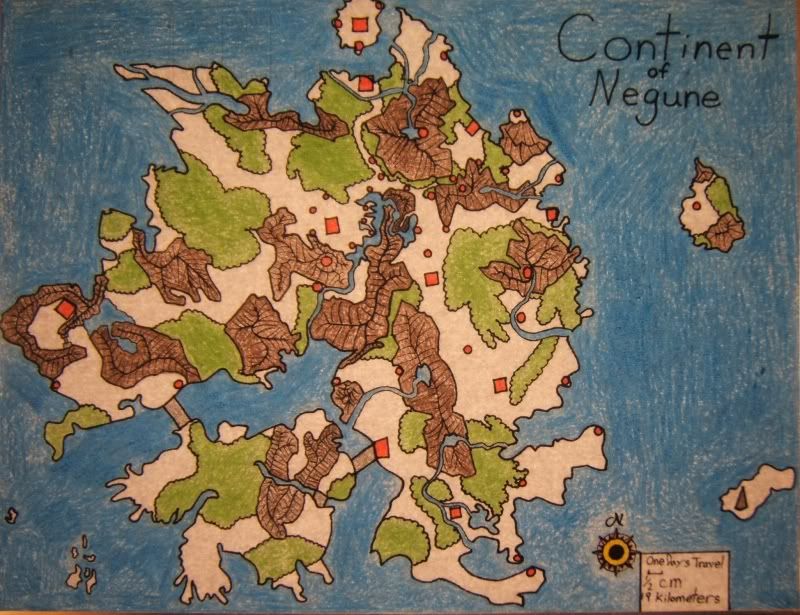
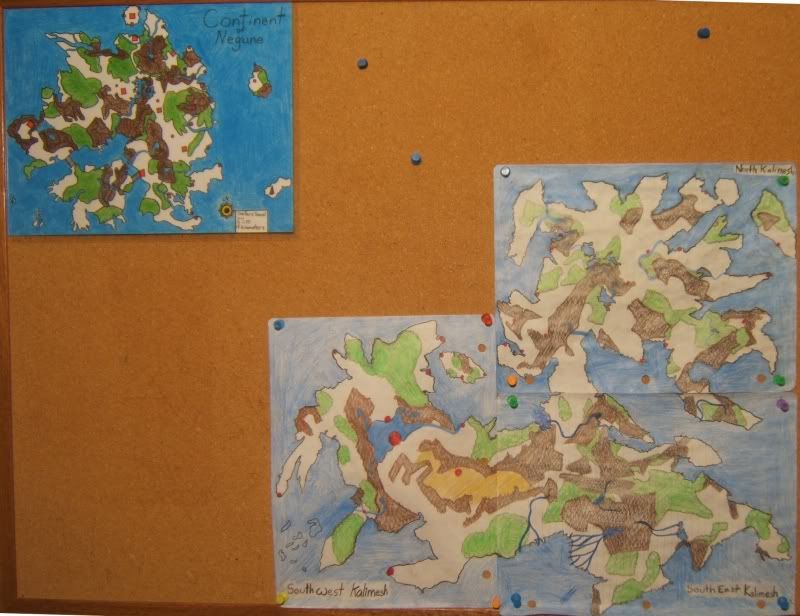
With that out of the way, lets get started. Here's a picture of my current campaign world to provide a sense of what results might look like:


And here's a close up of the primary continent, which my group hasn't ventured off of yet:


All of these were created using the Paper Drop Method, which requires just a few very basic tools I was able to gather from around my apartment:
1) Two sturdy surfaces of even height, like two chairs.
2) A sturdy piece of glass. I pulled the door off of an old stereo cabinet for mine.
3) A good lamp which can be moved around without much trouble.
4) Paper. If you don't have this, you may be in the wrong hobby.


Once you've got these items, place the glass across the two sturdy surfaces, and position the lamp underneath the glass, facing upwards towards it. Congratulations, you've constructed a tracing table! It's not fancy, but it's effective.

I'm unable to take a photo of a tracing table at the moment, however you
can see one on the right side of this old photo of my workstation.


At this point, rip up a few sheets of paper. The pieces should be relatively small, but not so small they become a nuisance. I would so no bigger than a palm, no smaller than a fingernail. Try to vary the shapes as best you can as well. Squares, triangles, circles, long pieces, squat pieces, any shape which strikes your fancy. Continue tearing up paper until you've got a nice little pile of it. Two or three sheets is usually sufficient.

Now, shredded paper in hand, drop it onto the tracing table from at least 2 or 3 feet high. It should rain down onto the glass, creating the shape of your continent. It's up to you whether you want to pick up the pieces which land on the floor and re-drop them, I prefer to let just remove them.

With the paper on the surface of the glass, the shape of the continent is established. You can now place another piece of paper over the pile of shredded pieces, turn on the light, and outline the shadow your pile of shredded papers makes. This step can be something of a pain in the ass, since the shredded pieces are easy to jostle around while you're tracing, no matter how careful you try to be. The easiest solution, I've found, is to put another sheet of glass between the shredded paper and the drawing paper.

Once you've got the outline of the map completed, repeat the earlier paper-dropping process with fewer pieces of paper. One drop for your forested regions, another for your mountainous regions. Mountains whose paper-shadow extends beyond the coast could potentially become islands rather than mountains, or simply be ignored as you prefer.

The placement of water on the map is best not done randomly. Even the least aware player may give you a cockeyed look if your rivers flow through mountain ranges rather than around them.

For smaller scale maps, I sometimes use the Atlas Jumble Method. My grandfather has mountains of local map books he accrued during his career as a backhoe operator--maps which cover most of the geographically diverse state of Washington. He gave me one which was published in 1995, and after finding it among my things recently, I struck upon an idea.

I took a few pages of maps, photocopied them, cut the copies into roughly 1" square pieces, and dropped all the pieces into a bowl. I then drew the squares out one by one, and arranged them from top left to bottom right on my tracing table, forming a shape roughly 8.5" x 11". After placing another sheet of glass on top of the pieces so as not to disturb them, I started drawing the map I had created onto a piece of paper.

Not a single one of the pieces matches up with any of the others, of course. Roads and rivers begin and end ever inch, and elevations and climates change without reason or warning. But this is where I'm able to exercise creativity by adding or removing elements from the map. Some roads to stop at dead ends, perhaps because there is untamed wilderness beyond the last town. I alter the course of other roads, so that they can meet up with roads on the next piece. And then I come up with a reason why the road needed to be built with such a meandering course.

The atlas jumble method isn't as simple as the paper drop method. It requires creative applications of all the "connect the dots" skills we haven't had much use for since we were children. But if you need an adventuring map and you don't know where to start, this method is an excellent springboard for creativity.

Last, I want to talk about a method I've never attempted, but am eager to try someday, The Paintball Method.

Essentially, I want to shoot a sheet of glass with a paintball gun a bunch of times, then flip the glass around, stick a light behind it, and trace whatever shapes I've got. I figure I could potentially even use paint balls with colors corresponding to geography. Green paint for forests, brown for mountains, yellow for planes, blue for waters.

I've got no idea if it will work, and unfortunately paint ball equipment is expensive. I still would love to try it, though.

And yes, I did pull all the method names out of thin air just to make the post sound more authoritative. How did you guess?

Monday, October 10, 2011

Magically Generating New Adventures

When I was 12 I finally got the opportunity to begin learning how to program on a second-hand computer my uncle was throwing out. For reasons I'm not entirely certain of, programming didn't remain a major pursuit of mine. The time I spent fervently perfecting my simple programs did teach me a lot, though. Among other things, I learned to appreciate the beauty of randomness. So it should come as no surprise to anyone that I enjoy a hobby where life and death often hang on a roll the dice.

In recent years I've become more interested in using randomness to aid in my creative process as a GM. I've worked on creating systems for randomly generating a variety of gaming elements, from dungeons, to species, to entire campaign arcs. One of my proudest achievements was my random NPC generator. It was one of the most ambitious programming projects I ever undertook, and I made a lot of progress with it. Unfortunately, my ability to construct the system was far more advanced than my ability to code the system, and the project has largely fallen by the wayside.

In this post, however, I'd like to talk about one of the simplest, most elegant and most entertaining systems of random generation I've come up with. I use it for adventure generation, but I imagine it could be adapted to be used for any length of narrative, up to entire campaign arcs.

The idea came to me one afternoon after an extended game of Magic: The Gathering with some friends. Most of my friends find the game much more entertaining than I do, so I was sitting out for a round. While they played, I browsed through the four boxes of cards I've accumulated, just enjoying the artwork. I came across one particularly devilish monster (I don't recall which) and thought it would be great to throw against my players in an upcoming session of D&D.

Then my eyes snapped open wide as I realized that Magic and D&D take place in environments so similar that every magic card is a potential element in a D&D game. I quickly grabbed a piece of paper and worked out the system which, even then, seemed so simple as to hardly need codifying.

1) Either: predetermine the game elements the cards will represent, or decide to establish those elements after the cards are drawn.

2) Either: separate the cards into categories (artifact, creature, land, sorcery...), or decide to draw them from one huge pile.

3) Determine the number of cards you will draw. (and, possibly, from which piles you will draw them.)

4) Draw the number of cards you decided on in step 3, according to the conditions established in steps 1 and 2. Use any element found on the card (art, game effects, flavor text, or even just the card's name) as a seed from which to develop the game.

To just write it out like that doesn't seem very clear, so below are a few examples of this. For the first draw, I used the "Random Card" function on Gatherer. I won't predetermine which cards correlate with which game elements, nor will I separate the cards into categories. I will draw four cards.


The first thing that strikes me about these cards is the power and majesty of the Great Sable Stag. It seems a paragon of nature. This is in contrast to the Hellkite hatchling, which looks like a pretty evil dragon. Flashfreeze has some nice art of a sagacious old man on it, but I think I'd like to make this card into a kind of freezing trap which shows up in the game. Mentor of the Meek is kinda throwing me for a loop, but I've found that things work out best if I don't discard cards which are difficult to fit into the idea. Maybe I can maybe work him in as the questgiver.

After some additional mulling, this is what I've come up with:


In a town on the outskirts of society, near an immense and unexplored forest, there are no inns for the players to stay in. Here, there is a strong presence of temples which offer free hospitality to travelers. While staying in one such very crowded temple, the PCs find themselves sitting at a table with a group of elderly pilgrims equal in number to the party. After some brief role play has allowed the players to familiarize themselves with their table companions, the server brings food. Unfortunately, the temple is overcrowded, and only has enough food for half the people at the table.

This is a test. If the PCs share the food, or offer it to the elderly pilgrims, they are approached by a young monk wearing light leather clothing, and a sword strapped to his side. He asks if he can speak with them, and takes them to a small side room with chairs, a table, and food for the players. They have impressed him with their generosity, and he would like to ask a favor of them. In the deep forest is a creature called the Playton Stag. It is a beautiful, and terrible, creature. All other stags in the world are a reflection of this one great animal.

Recently, a nearby Ancient Red Dragon named Ashrain gave birth to a whelping, and is teaching him to hunt in the great woods. Normally this would be of little concern, but the temple's seers have foretold that Ashrain intends to continue hunting until her whelp can devour the Playton Stag.

To prevent this, the monk would like the party to capture the Playton Stag, and bring it back to the city where the monks can hide it until Ashrain grows bored of her grisly sport.

There is one snag, however. Any creature which touches the Playton Stag is instantly affected by a Time Stop spell, lasting one hour. The players must somehow return the creature to the town without ever touching it, lest they be easy prey for the creatures of the forest, or the dragons.


There are two things about this which I would like to point out. First, despite pulling 3 creature cards and a spell card, the game outline I worked up is not combat based. In fact, the primary goal of the adventure is more akin to solving a puzzle than anything else. Second, and most important, this is not an adventure I would have come up with on my own. It's not my style, which means that the system is doing exactly what I want it to do: making me think differently. Forcing me to break my own patterns by forcing me to try to find patterns in randomness.

I think the concept is pretty clear at this point, but I'll provide one more example to demonstrate the alternatives available in steps 1 and 2 of the process. This time I'll be drawing from my own collection. I will predetermine the elements the cards will represent, but I will not sort the cards into categories.

The first card will be what the heroes are after on this adventure.
The second and third cards will be the challenges they must face.
The fourth card will be the unexpected help along the way.
The fifth card will be what sent them on their journey.
The sixth card will be what special treasure they have an opportunity to find.

I will now draw from my collection, and post the cards below in the order I drew them.


Now, you might look at this and see it as an unfortunate draw. What the players are after appears to be nothing more than a mundane owl, their unexpected help comes from a mindless and violent creature, and one of the obstacles they must overcome is an attractive young woman. But this is precisely what we want when we predetermine what cards will be associated with which game element. It forces us to further stretch our minds, to further break from our own patterns. I'll keep this one short since the post is starting to run long.


After defeating a mad pyromancer, the party discover a journal whilst looting her body. It turns out she was hunting for a missing artifact. She had recently pinpointed its location: the ancient Amrou people who had hidden it had allowed an owl to swallow it, and enchanted the owl so that the artifact would be passed to its children. For generations, this family of owls has hunted among the Tempest Falls--a breathtaking and rare cluster of waterfalls in a far off land.

Along the way, the party is hounded by the forgotten descendants of those who first hid the artifact. However, if they looted a special amulet from the pyromancer, they will discover that it has an unusual ability. Whenever one of Amrou blood is near, it will summon a basilisk. The basilisk will attack the Amrou on sight--and will attack the players if it cannot find any Amrou nearby after being summoned. This makes any attempt at peace very difficult.

If the party successfully finds and slays the owl, the moment it dies, a great rumbling is heard, and an ancient war construct rises from beneath the earth to kill those who have breached the sacred trust of the Amrou.

Once the construct is defeated, and the players are finally able to examine the orb from the owl's belly. If they are able to use magic to identify it, they will discover that once per day, it may be used to attempt to force a permanent 1 step alignment shift in another creature. Will save DC: 17, may not be used on the same creature twice regardless of success or failure.


So there you have it. Generating new adventures via magic. It's not the only way of coming up with new ideas, but it's one very good and fun method to try.
Related Posts Plugin for WordPress, Blogger...